Kittery Water District’s Terms & Conditions are available to Download the Official Approved Terms & Conditions (PDF) on the District website.
TERMS AND CONDITIONS
The following Terms and Conditions made by the Kittery Water District and filed with the Maine Public Utilities Commission constitute a contract between the Customer and the Utility. The Customer agrees to adhere to these Terms and Conditions and to take water only for purposes stated in the application and at the current established rates.
DEFINITIONS
“Backflow” refers to the undesirable reversal of flow of a liquid, gas, or suspended solid into the potable water supply.
“Backflow Preventer Device” refers to the device used to protect potable water supplies from contamination or pollution due to backflow. Common types include Reduced Pressure Zone (RPZ) assemblies, Double Check Valve Assemblies (DCVA), and Pressure Vacuum Breaker (PVB).
“Back-Siphonage” refers to the condition that occurs when higher pressure fluids, gases, or suspended solids move to an area of lower pressure fluids.
“Board” refers to the Kittery Water District Board of Trustees
“Commission” refers to the Maine Public Utilities Commission.
“Cross Connection” refers to the points at which a potable water system connects with a non-potable water system.
“Curb Stop” shall mean the valve located on the service line at or near the public right-of-way line and used to shut off the water service outside the premises being served. This is the point on the service line which defines ownership, Main to Curb Stop is owned by Utility, Curb Stop to Meter and all connection parts around the Meter are owned by the Customer.
“Customer” means any person, firm, corporation or governmental division who has applied for and is granted service or who is responsible for payment of the service.
“Main” means a water pipe, owned, operated and maintained by the Utility, which is used to transmit or distribute water but is not a water Service Line.
“Normal Business Hours” means Monday – Friday, excluding holidays, 7:00 am – 3:00 pm
“Other Hours” means any hours that are not Normal Business Hours.
“Seasonal Customer” means a Customer who takes water service for a portion of the year from either a summer or year-round Main.
- Summer Service Pipes and Water Mains. “Summer Service Pipes and Water Mains” are pipes which can supply properties for only a portion of the year, typically from May 1 to November 1. The Utility may elect to extend service before May 1 or after November 1. (Chapter 62 §2E)
“Service Line” mean the pipe running from the Main in the right-of-way to the meter on the Customer’s property to serve the dwelling.
“Thermal Expansion” is the tendency of matter to change its volume, area, or length in response to temperature.
“Thermal Expansion Tank” is a safety device designed for “closed-loop” plumbing systems that feature a backflow preventer or check valve. When water is heated, it expands, and if a backflow preventer prevents this increased volume from flowing back into the municipal water supply, the resulting pressure buildup can damage pipes and water heaters.
“Utility” refers to the Kittery Water District.
“Water Meter” refers to the Utility owned water usage reading device that registers Customer water usage. The water meter, meter register, remote reading device, radio transmitter, endpoint, communication equipment, seals, and associated Utility-installed components shall remain the sole property of the Utility regardless of location on the Customer’s premises.
1.UTILITY SERVICE AREA
The District is permitted by charter to serve within the boundaries of the Towns of Kittery and Eliot, and portions of the Town of York, as established by the District’s 2021 charter, which repealed and replaced the prior charter provisions governing the District’s service area.
2. APPLICATION FOR SERVICE
Pursuant to Chapter 620 of the Commission’s Rules and Regulations, the owner or the owner’s agent, or the occupant of the establishment to be served may apply for service on forms provided by the Utility.
Service provided by the Utility is subject to these Terms and Conditions and all applicable Maine Public Utilities Commission Rules and Regulations. By applying for and establishing service, Customers agree to comply with such requirements and acknowledge the Utility’s authority to install, maintain, repair, replace, upgrade, and operate Utility-owned infrastructure, equipment, metering systems, communication systems, and related technologies necessary for the provision of service. Utility-owned infrastructure and equipment may be modified, upgraded, replaced or reconfigured from time to time as determined necessary by the Utility for operational, regulatory, safety, reliability, efficiency, or service-related purposes.
If seasonal rental property, only the property owner may be an applicant for service. Any tenant may become a Customer if the tenant assumes responsibility for future service under the conditions set forth in Title 35-A M.R.S. §706(2), Chapter 660 of the Commission’s Rules and Regulations, and under Section 13 below. If a new service connection or other work on the establishment is required, the owner must authorize the Utility to enter the premises to do the necessary work.
Acceptance and continuation of water service constitutes permission for the Utility and its authorized representatives to enter the property at reasonable times for purposes of reading, inspecting, testing, maintaining, repairing, replacing, or upgrading Utility-owned facilities necessary to provide service.
3. SEASONAL CUSTOMER
A seasonal Customer regularly takes service for only a portion of the year from either a summer or year-round main. A seasonal Customer will be subject to the rules and charges of most current seasonal rates, if in effect, or of the most current annual rates, if seasonal rates are not in effect. A Customer regularly vacating the premises for three months or less may elect in writing to be classified as an annual Customer subject to annual rules and charges.
The overground water mains on Goodwin Road, Tower Road, Cutts Island Lane, Seapoint Road, Thaxter Lane, Pocahontas Road, and Sea Oaks Lane are considered public seasonal water mains located on private roads. The Utility shall require easements, rights-of-way, or access agreements reasonably necessary for the installation, operation, maintenance, repair, replacement, inspection, or extension of Utility-owned facilities.
The recommended seasonal water usage for each residential unit served by these seasonal water mains is 10,000 cubic feet (74,800 gallons). Due to excessive water demand and irrigation usage, the Utility can no longer support additional Customers on the existing seasonal water main system. The Utility reserves the right to deny additional connections where existing system capacity is insufficient to support additional demand.
As the existing overground water mains are upgraded by the Utility to 4-inch HDPE water mains, any future extensions or expansions required to serve additional properties or increased water demands shall be the responsibility of the applicable road association and/or benefiting property owners.
All costs associated with future in-ground water main extensions shall be paid by the current or new Customers benefiting from such extensions.
Any upgraded or replacement water mains installed under this program shall become Utility-owned facilities and shall be subject to any easements, rights-of-way, or access agreements required by the Utility.
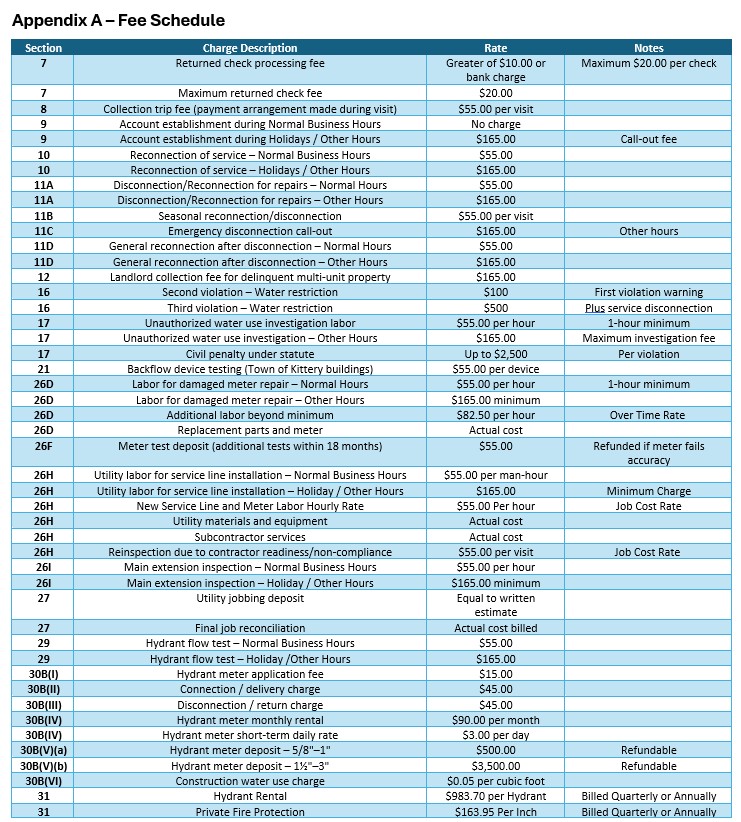
The Utility will flush seasonal water mains as necessary to maintain water quality within the distribution system. All fire protection devices connected to the seasonal water main system shall be operated solely by the Utility. See Appendix A for the Fee Schedule and Appendix B for the Jobbing Rates.
4. BILLING PROCEDURES
Minimum meter charges for annual metered service, and water used in excess of the minimum shall be billed quarterly in arrears at the end of the billing quarter. The Utility reserves the right to render bills monthly and/or in advance at its discretion.
Seasonal minimum meter charges will be billed immediately after the meter is set for the season. Bills for water used in excess of the minimum shall be billed immediately after the final reading for the season. The Utility reserves the right to render bills quarterly for minimum meter charges and/or for excessive water used by seasonal Customers.
Public and private fire protection charges will be billed in arrears each year on an annual basis. The Utility reserves the right to bill semiannually or quarterly and/or in advance if it so desires.
Bills may be paid by any Utility-approved payment method, including but not limited to by mail, online or in person, and must be received at the offices of the Utility or at any designated collection station. Failure of the Customer to receive his/her bill does not relieve him/her of the obligation of its payment nor for the consequences of non-payment. It is the Customer’s responsibility to provide correct billing or email addresses. See Appendix A for the Fee Schedule and Appendix B for the Jobbing Rates.
5. CREDIT AND COLLECTION PROCEDURES
All credit and collection procedures for both residential and nonresidential Customers will be based upon Chapters 660 and 870 of the Commission’s Rules and Regulations. The Utility may demand a deposit from a Customer as permitted by Chapter 660. Pursuant to Chapter 870, the interest rate on Customer deposits will be the rate set from time to time by the Commission.
6. TERMS OF PAYMENT
Customers are legally obligated to pay for the services they receive. Bills are payable upon being issued. Failure of the Customer to receive his/her bill does not relieve him/her of the obligation of payment for services received nor for the consequences of non-payment. It is the Customer’s responsibility to provide correct billing information or email addresses. The due date for payment, in order to avoid the incurrence of late fees or the initiation of collection action, will be no less than 25 days after the bill is mailed or hand delivered. The late payment charge for overdue bills will be no more than the maximum amount allowed under Chapter 870 of the Commission’s Rules and Regulations, to be determined annually.
7. CHARGE FOR RETURNED CHECKS
Pursuant to Chapter 870 of the Commission’s Rules and Regulations, the Utility may charge a fee for each check returned by a bank. If the Utility charges an amount in excess of the fee set forth in Appendix A, the Utility shall furnish the Customer with proof of the bank charge. See Appendix A for the Fee Schedule and Appendix B for the Jobbing Rates.
8. COLLECTION TRIP FEE
If Utility personnel visit the Customer’s premises to disconnect service for non-payment and, in lieu of actual disconnection, the Customer pays or makes a payment arrangement for the entire past due balance, the Utility will charge a collection fee at the time of the visit, as permitted by Chapter 660 of the Commission’s Rules and Regulations. See Appendix A for the Fee Schedule and Appendix B for the Jobbing Rates.
9. CHARGE FOR ESTABLISHMENT OF SERVICE
The Utility will not charge a fee to establish an account during Normal Business Hours. A call-out fee will apply for account establishment during holidays or Other Hours. See Appendix A for the Fee Schedule and Appendix B for the Jobbing Rates.
10. CHARGES FOR RESTORATION/RECONNECTION OF SERVICE
The Utility will charge a Customer a reconnection fee for restoration of service at the Customer’s dwelling if service was disconnected for any reason allowable under Chapter 660 of the Commission’s Rules and Regulations and/or under these Terms and Conditions. The applicable reconnection fee shall be due in advance as a condition of service. See Appendix A for the Fee Schedule and Appendix B for the Jobbing Rates.
11. CHARGES FOR DISCONNECTION OF SERVICE AND/OR THE ASSOCIATED RESTORATION OF SERVICE
The following provisions identify Customer charges for disconnection of service and the associated restoration of service for any reason allowable under Chapter 660 of the Commission’s Rules and Regulations and/or under these Terms and Conditions:
- Disconnection and/or reconnection of service for the purpose of repairs may be subject to different charges during Normal Business Hours, holidays, and Other Hours.
- Seasonal disconnection and/or reconnection of service for returning Customers, including restoration of service at the onset of the season and discontinuance of service at the season’s end, shall be charged per visit.
- Emergency disconnection of service during Other Hours shall be charged at the applicable Other Hours rate. In the event that, during such call-out, the Utility repairs or replaces a damaged meter as defined in Section 26D, the applicable call-out fee under this section will be waived to prevent a duplicate charge.
- Reconnection of service following disconnection, for reasons other than those listed elsewhere, may be subject to different charges during Normal Business Hours, holidays, and Other Hours.
See Appendix A for the Fee Schedule and Appendix B for the Jobbing Rates.
12. DISCONNECTION OF LEASED OR RENTED PROPERTY
Before disconnecting a leased or rented residential property, the Utility shall comply with the notice requirements contained in Chapter 660 of the Commission’s Rules and Regulations, and shall offer the tenant the right to take responsibility for future payments.
- Leased or Rented Single-meter, Multi-unit Residential Property: Pursuant to Chapter 660, in addition to the above, before disconnecting a leased or rented single-meter, multi-unit residential property, the Utility shall:
- Apply any existing deposit to the current account balance, and
- Assess against the landlord a collection fee, in addition to any applicable reconnection fee set forth in Section 10 of these Terms and Conditions.
At its discretion, the Utility may separately meter or cause to be separately metered, at the property owner’s expense, each dwelling unit within the property. See Appendix A for the Fee Schedule and Appendix B for the Jobbing Rates.
13. SERVICE INTERRUPTION
As specified in Chapter 660 of the Commission’s Rules and Regulations, the Utility will provide reasonable notice of any planned shut-off to affected Customers. If the interruption is expected to last more than 5 hours or to affect more than 10 Customers or a single commercial Customer on a dedicated line, notice will be given at least twenty-four hours in advance of the interruption of service unless an emergency exists. The Utility will notify the Customers when practicable of the cause and duration of any unplanned shut-off. Pursuant to Chapter 620, if a Customer requests, the Utility will make a pro rata reduction in the Customer’s minimum bill if service is interrupted for longer than forty-eight hours and the interruption is not due to negligence or improper care of equipment by the Customer.
14. ACCESS TO PREMISES
Pursuant to Chapter 620 of the Commission’s Rules and Regulations, as a condition of service, Customers shall provide properly identified Utility employees access to all premises supplied with water, at all reasonable hours, to inspect plumbing and fixtures; ascertain the amount and manner of water use; set, read, test, maintain, repair, replace, upgrade, reprogram, operate, or remove Utility-owned meters, communication devices, endpoints, backflow prevention devices, and other Utility-owned equipment; and otherwise enforce these Terms and Conditions.
15. LIABILITY
The Utility will only be liable for any damages arising from claims to the extent liability is expressly provided in the Maine Tort Claims Act, as set forth in Title 14 MRSA, Chapter 741. The Utility will not be responsible for any damages caused by discolored water and makes no representations or warranties, expressed or implied, about the suitability of any water provided by the Utility for any particular purpose.
The Utility shall not be liable for any damage to, failure of, or reduction in performance of customer-owned plumbing, filtration systems, inline filters, water treatment equipment, hot water tanks, appliances, or other equipment located on the Customer’s side of the service connection. The Customer shall be solely responsible for the ownership, operation, maintenance, repair, and replacement of such equipment.
16. CONSERVATION
All Customers shall minimize the waste of water. Pursuant to Chapter 620 of the Commission’s Rules and Regulations, when necessary to conserve the water supply or in the event of an emergency, the Utility may restrict or prohibit waste or improper usage for all Customers, including but not limited to the use of hoses and lawn sprinklers. Under these conditions, the Utility will decide what constitutes waste and improper usage in order to protect the safety of the water system.
Water Use Restrictions
The purpose of this section is to ensure that water use is regulated in a manner that the Board, with the approval of the Maine Drinking Water Program, deems to be in the best interests of the Utility and its Customers. The Board shall use reasonable means to protect, preserve and maintain the public health, safety and welfare when a water supply shortage exists.
The Utility Board adopts this term under its authority to regulate public water systems pursuant to Chapter 620, and the authority granted by the Maine Drinking Water Program. The requirements of this section shall apply to all water users with connections receiving water from the Utility.
By definition, a water supply shortage is a situation when insufficient water is available to meet the present or anticipated needs of the water system. A water supply shortage usually occurs due to drought or a major infrastructure failure.
Upon declaration of a State of Water Supply Shortage or other water emergency, the Board, with the approval of the Maine Drinking Water Program, shall be authorized to determine and implement restrictions necessary to conserve and maintain adequate reserves of the public water supply. Provided there is a declaration as noted above, the following levels of progressive restriction shall apply immediately after the public notification period specified below.
- If the Board issues a Level 1 restriction, then:
- The public is requested to refrain voluntarily from landscape watering and to limit the amount of water used outdoors for other purposes.
- Landscape watering shall not occur between the hours of 8:00 am and 7:00 pm.
- If the Board issues a Level 2 restriction, then:
- Landscape watering by odd numbered addresses is allowed on odd numbered days.
- Landscape watering by even numbered addresses is allowed on even numbered days.
- Landscape watering shall not occur between the hours of 8:00 am and 7:00 pm.
- TRC approvals shall be suspended and will not be granted during a Level 2 or higher restriction.
- If the Board issues a Level 3 restriction, then:
- Landscape watering by odd numbered addresses is allowed on Mondays and Thursdays.
- Landscape watering by even numbered addresses is allowed on Tuesdays and Fridays.
- Landscape watering shall not occur between the hours of 8:00 am and 7:00 pm.
- If the Board issues a Level 4 restriction, then:
- Landscape watering is prohibited.
- The filling of swimming pools greater than 100 gallons capacity is prohibited.
- Washing of streets, driveways, sidewalks or other impervious areas is prohibited.
- Washing of vehicles or boats at a non-commercial facility shall be prohibited.
- Exceptions to restrictions include the following:
- Hand irrigation of crops used for food by residents at a residential property shall not be restricted.
- Water to sustain animal life shall not be restricted.
- Commercial car washes, cash crops, farms, flower shops or garden centers shall not be restricted.
- Orders imposing water use restrictions shall not apply to uses that obtain water from sources other than the public water supply, unless it can be clearly demonstrated that the use of such water directly affects the public water supply (example – private wells).
Notification of intent to implement water use restrictions by the Board due to a water supply shortage shall be posted three days prior to effective date in two public locations and published in a newspaper of general circulation within the Utility or by such other means reasonably determined to notify all affected water users.
The Board shall coordinate with the Maine Drinking Water Program to determine that the water supply shortage no longer exists and may terminate the water use restrictions. Public notification of the termination of water use restrictions shall be provided in coordination with the Maine Drinking Water Program.
Any person failing to comply with the restrictions imposed pursuant to this term shall be subject to a fine and/or civil penalties pursuant to Section 17 of these Terms and Conditions. Recovered penalty fees shall be used as the Utility may direct. In addition to the foregoing penalties, the Utility is authorized to discontinue water service where orders and restrictions have been violated. Such discontinuance shall be made pursuant to Section 11 of these Terms and Conditions and may be continued so long as there is evidence that the violations will continue.
- First violation: Written warning delivered to the site of the violation.
- Second violation: Fine as set forth in Appendix A.
- Third violation: Fine as set forth in Appendix A and discontinuance of water service.
All applicable fees shall apply in addition to any fines or penalties, including, but not limited to, fees for water discontinuance and reconnection. See Appendix A for the Fee Schedule and Appendix B for the Jobbing Rates.
17. UNAUTHORIZED USE OF WATER
No Customer shall supply water to another, nor use it for any purpose not identified in the Customer’s application, without Utility approval. No Customer, or the Customer’s agent, shall obtain water from any hydrant or other fixture of the Utility without the prior consent of the Utility. No Customer, or the Customer’s agent, shall bypass any meter, restore service without Utility authorization, unreasonably interfere with Utility service, or otherwise take any action to prevent the proper metering of water consumed by the Customer.
Upon discovery of such unauthorized use of water, the Customer shall be immediately disconnected pursuant to Chapter 660 of the Commission’s Rules and Regulations. In addition, the Utility shall be entitled to bill and recover from the Customer or responsible person the cost of the estimated amount of water consumed, based on the Utility’s approved rates, plus interest at an annual rate of 5%.
Where unauthorized use of water has occurred, the Utility may also assess the Customer or responsible person an hourly fee, for a minimum of one hour, for each service visit to the Customer’s premises necessary to investigate and address the unauthorized use of water, including, but not limited to, removing the meter bypass, taking measures to prevent further diversion of water, and verifying that corrective measures have been taken and maintained. Applicable fees are set forth in Appendix A.
In addition, pursuant to Title 35-A M.R.S. § 2706, as amended or replaced, the Customer or person responsible for the unauthorized use may be liable in a civil action to the Utility for all other reasonable costs incurred by the Utility, including attorney’s fees, costs of undertaking and completing the investigation resulting in the determination of liability, and the applicable civil penalty, as set forth in Appendix A, for each violation. See Appendix A for the Fee Schedule and Appendix B for the Jobbing Rates.
18. NO TAMPERING WITH UTILITY PROPERTY
No person shall tamper with Utility property. No valve, valve sealing mechanism, meter, shutoff, hydrant, or standpipe that is the property of the Utility shall be opened, closed, operated, modified, or removed by any person other than one authorized by the Utility. Tampering shall subject the Customer or other responsible party to the same charges and actions set forth in Section 17, Unauthorized Use of Water. In addition, in the event of such tampering, the responsible party may be subject to a civil action pursuant to Title 35-A M.R.S. § 2707, as amended or replaced.
19. MAINTENANCE OF PLUMBING
Pursuant to Chapter 620 of the Commission’s Rules and Regulations, the Customer shall maintain the plumbing and fixtures within the Customer’s premises in good repair and protect them from freezing and heat damage. If damage occurs, the Customer shall be liable for any resulting expense. A leak or break that is considered a threat to the integrity of the system shall be cause for immediate disconnection of service. If a leak is discovered that is not considered an immediate danger to the system, but may pose a long-term or cumulative risk, the Customer shall be notified in writing by the Utility and shall be given 30 days to repair the leak. If the repair is not completed within that time, the Customer shall be subject to a fourteen-day disconnection notice pursuant to Chapter 660 of the Commission’s Rules and Regulations.
The Customer shall also be responsible for maintaining any filtration system(s), including filter cartridge replacements, and any other specialized water devices within the Customer’s premises.
20. CROSS CONNECTIONS
Pursuant to Chapter 620 of the Commission’s Rules and Regulations, no cross-connection between the public water supply system and any other supply shall be permitted unless properly protected by approved backflow prevention devices, as required by the Maine Cross Connection Control Rules of the Maine Drinking Water Program and the Maine Internal Plumbing Code. No new cross-connection may be installed without the express written approval of the Utility.
In addition, no connection shall be permitted that is capable of causing backflow, including back-siphonage or backpressure, between the public water supply system and any plumbing fixture, device, or appliance, or between any waste outlet or pipe having a direct connection to waste drains. If the owner of such a connection fails or refuses to remove or properly protect the connection within the time specified by the Utility, the Utility may disconnect service pursuant to Chapter 660 of the Commission’s Rules and Regulations.
The Utility’s Cross Connection Control Program is on file at the Utility office. If a backflow prevention device is installed, the Customer shall be responsible for addressing any thermal expansion conditions that may result. A thermal expansion tank is a safety device designed for closed-loop plumbing systems and may help prevent excessive pressure from damaging pipes and water heaters.
21. BACKFLOW-PREVENTION DEVICE TESTING
The Utility will test backflow prevention devices for Town of Kittery-owned buildings at the applicable rate set forth in Appendix A. All other Customers with testable backflow prevention devices shall be responsible, at their own expense, for completing device testing in accordance with the Utility’s required testing schedule during the calendar year, January 1 through December 31.
The Customer shall select a certified professional to perform the required testing and shall be responsible for paying the contractor directly for all testing and any necessary repairs. Upon completion, the Customer shall provide the Utility with a copy of each signed certified test report no later than December 31 of each year.
Customers who fail to comply with testing requirements and/or fail to complete recommended repairs to their devices shall be subject to disconnection as a dangerous condition pursuant to the Utility’s Cross Connection Control Program and Chapter 660 of the Commission’s Rules and Regulations. See Appendix A for the Fee Schedule and Appendix B for the Jobbing Rates.
22. STOP VALVES
As permitted by Chapter 620 of the Commission’s Rules and Regulations, every service shall be provided with a minimum of two operable stop ball valves located inside the building, readily accessible and protected from freezing, one near the service entrance before the meter and check valve, and one after the meter and check valve. All plumbing shall be installed in accordance with applicable plumbing codes to prevent back-siphonage and to permit draining whenever necessary. Customers shall also review the Utility’s installation standards for service and meter installation.
23. FLUCTUATION OF PRESSURES BY CUSTOMER’S APPARATUS
Pursuant to Chapter 620 of the Commission’s Rules and Regulations, no Customer shall install or use any device that may affect the Utility’s pressure or water quality without the prior written permission of the Utility.
24. SAFEGUARDING DIRECT PRESSURE WATER DEVICES AND SYSTEMS SUPPLIED BY AUTOMATIC FEED VALVES
Pursuant to Chapter 620 of the Commission’s Rules and Regulations, as a condition of service, Customers shall install vacuum, temperature, and pressure relief valves or cutouts to prevent damage to any direct pressure water device or secondary system supplied by an automatic feed.
25. JOINT USE OF SERVICE PIPE TRENCH
Pursuant to Chapter 620 of the Commission’s Rules and Regulations, water Service Pipes shall not be placed in the same trench as other utility facilities under normal conditions. Where practicable, a horizontal separation of ten feet shall be maintained. Where extenuating, unusual, or special circumstances are encountered, a lesser separation or joint use of a trench may be permitted upon agreement of all parties, provided the installation complies with all applicable laws, rules, and regulations. Installation shall conform to AWWA Standard C600. Customers shall also review the Utility’s installation standards for service and meter installation.
26. METERING AND NEW SERVICE LINE AND MAIN EXTENSION POLICIES
- Separate Metering of Buildings: No Customer shall supply water to another, nor use it for any purpose not identified in the Customer’s application, without the prior written approval of the Utility. At its discretion, the Utility reserves the right to require separate piping, a separate meter, and a separate shut-off for each building or trailer as a condition of service. Except as provided in Chapter 660 of the Commission’s Rules and Regulations, where there is more than one occupant of a building supplied with water, the Utility may require the owner to arrange the plumbing to permit separate connections with shut-offs and meters, in locations acceptable to the Utility, for each place of business or abode. The cost of the meter, appurtenances, and installation shall be borne by the Customer. Meter size shall be determined by the Utility. The Utility will provide the basic meter connection parts necessary for a plumber to install the connection in preparation for proper meter installation by the Utility. For meter sizes 1 inch or smaller, the Utility will provide a straight meter connection, meter gaskets, a meter base for lay length, and one dual residential check valve, if applicable. Larger meter connections shall be the responsibility of the plumbing contractor or, if supplied by the Utility, all associated parts shall be charged to the Customer. The Utility will not supply the required larger dual residential check valve or testable backflow prevention device. Customers shall also review the Utility’s installation standards for service and meter installation. See Appendix A for the Fee Schedule and Appendix B for the Jobbing Rates.
- Metering of Multi-Unit Developments: With the specific exception of hotels, motels, and as otherwise specifically excluded herein, this term applies to all multi-unit developments, including, but not limited to, condominiums, apartments, mobile home parks, cottages, commercial and retail units, and other similar units within residential and commercial developments. This term also applies to all conversions of an existing building or buildings to multi-unit residential or commercial developments. The Utility requires that each residential or commercial unit in a multi-unit development be individually metered, including units in a single building and units in multiple buildings within a larger development. The Utility reserves the right to allow a master meter for multi-unit residential or commercial developments. Design and construction of the system, including the sizing, location, and installation of meters, associated valves, and backflow prevention devices, shall comply with all Utility construction standards and material specifications. The cost of the meter, appurtenances, and installation shall be borne by the Customer. In the case of multi-unit time-share developments, each unit shall be individually metered; however, all meters within the same time-share development complex shall be billed to the complex owner, association, corporation, or other responsible entity. Customers shall also review the Utility’s installation standards for service and meter installation. See Appendix A for the Fee Schedule and Appendix B for the Jobbing Rates.
- Submetering: Additional or auxiliary meters used to show the subdivision of water use shall be furnished, installed, read, and maintained at the Customer’s expense.
- Charges for Repair or Replacement of Damaged Water Meters and Other Utility Equipment: Pursuant to Chapter 620 of the Commission’s Rules and Regulations, the Utility may charge a Customer for costs incurred in the repair or replacement of meter(s) or other Utility equipment damaged due to Customer negligence or improper care. Applicable labor charges and replacement part costs, including the meter, shall be charged to the Customer. See Appendix A for the Fee Schedule and Appendix B for the Jobbing Rates.
- Meter Pits: As permitted by Chapter 620 of the Commission’s Rules and Regulations, the Utility reserves the right to require a meter pit at the Customer’s expense under the following circumstances:
- The length of the Service Line from the curb stop to the structure exceeds 150 feet;
- The Customer does not provide a warm, dry, and accessible location for the meter and its appurtenances. Meters shall not be placed in crawl spaces, within living areas, or in unheated structures unless adequately protected from freezing. This requirement shall apply to any new or rehabilitated property and shall comply with the most current KWD construction specifications and these Terms and Conditions;
- The Service Line serves a mobile home, condominium, or small private development;
- The Service Pipe between the curb stop and the building has been constructed of materials that make leaks or catastrophic failure likely;
- A known Service Line leak remains unrepaired by the Customer, or the Service Line continues to fail two or more times within a two-year period;
- The Customer has a history of tampering with the meter, unauthorized use of water, or attempted theft of Utility services, materials, or equipment;
- The Utility reserves the right to require a meter pit for any new or rehabilitated property that is updated to meet the most current construction specifications and these Terms and Conditions; and
- The Utility shall specify the type and design of the meter pit and the materials to be used. Excavation work shall be performed by a qualified professional contractor. The contractor shall order and deliver the specified meter pit to the Utility shop. The Utility shall configure the meter pit with the meter connections necessary for installation in the ground. The contractor shall pick up, deliver, and install the meter pit at the excavation site. Utility staff shall connect the meter pit to the Service Line connections on the exterior of the meter pit. The Utility shall return at a later date to install the meter and backflow prevention device when water service is ready to be activated. Applicable charges for all parts, labor, and equipment used for the meter pit setup shall be as set forth in Appendix A. The Utility will also charge for the initial backflow test if a testable device is required. All charges shall be billed to the Customer or contractor. The Utility reserves the right to inspect the work to verify compliance with its construction specifications. Customers shall also review the Utility’s installation standards for service and meter installation. See Appendix A for the Fee Schedule and Appendix B for the Jobbing Rates.
- Meter Testing: The Utility shall test its water meters in accordance with the schedule and standards set forth in Chapter 620 of the Commission’s Rules and Regulations. Upon Customer request, the Utility will test the Customer’s water meter at no charge in the presence of the Customer or the Customer’s representative, unless the Customer requests more than one test within an 18-month period. If the Customer requests testing more frequently, the Utility may require the Customer to pay a deposit, as set forth in Appendix A, to cover the cost of the test. If a meter tested at the Customer’s request does not conform to applicable standards, the Customer’s deposit shall be refunded, and the Utility shall adjust the Customer’s bill in accordance with Chapter 620 of the Commission’s Rules and Regulations. If the meter conforms to applicable standards, the Utility may retain the Customer’s deposit and continue to use the meter at the Customer’s premises. See Appendix A for the Fee Schedule and Appendix B for the Jobbing Rates.
- Winter Construction: No new service or extension of Mains shall be installed for the convenience of a Customer during winter conditions that increase the cost of the work for the Utility unless the Customer assumes all additional expense above ordinary construction costs.
- New Service Lines and Meters:
- The Customer shall complete a written or online permit application for any new, repaired, replaced, or modified Service Line or water meter, and the Utility reserves the right to pre-approve the design. As permitted by Title 35-A M.R.S. § 6106, each applicant for new water service shall be responsible for the cost of the entire Service Line. All new Service Lines shall be installed in accordance with the Utility’s standards and material specifications. The Customer shall contract with a qualified professional contractor to complete the installation. Ownership and maintenance of the Service Line and meter after installation shall be governed by Chapters 620 and 650 of the Commission’s Rules and Regulations.
- The Utility shall own and maintain the service line portion of all Service Lines extending from the Main to the curb stop (shut-off valve). The curb stop shall normally be located at the limit of the public way or the Utility’s right-of-way. The Utility shall be responsible for all Service Lines within the limits of the highway or right-of-way. If a public way must be crossed, such crossing shall be installed in accordance with the Utility’s standards and material specifications by a qualified professional contractor, and all associated costs shall be paid by the Customer.
- As permitted by Title 35-A M.R.S. § 6106 and Chapter 620 of the Commission’s Rules and Regulations, the Customer shall install, at the Customer’s expense, and shall own and maintain the Service Pipe from the curb stop to the Customer’s premises. Costs incurred by the Customer shall include equipment rental, labor, materials, and necessary appurtenances for installation, including the meter connections surrounding the water meter. The Utility shall require individual Service Pipes and meters for individual dwellings, lots, or land parcels, regardless of ownership, and each Service Pipe shall be installed in accordance with the Utility’s standards and material specifications.
- The Customer shall obtain the Utility’s written approval for the work. Any plans requiring approval shall be submitted to the Utility office at least one month prior to the requested approval date. The Service Line location shall be established or reviewed by the Utility and shall be installed in accordance with the Utility’s standards and specifications, which are available at the Utility office or online. Only Utility-approved materials may be used. The Utility reserves the right to inspect materials and installation and must be notified before such materials or work are buried or enclosed. The initial inspection of contractor work shall be at no charge. If the Utility must perform a reinspection due to lack of readiness by the Customer or contractor, or due to noncompliance with the Utility’s standards and specifications, the Customer shall be responsible for the applicable reinspection charge as set forth in Appendix A.
- The qualified professional contractor shall be responsible for installing the Service Line from the Main to the curb box shut-off, and from the curb stop to the Customer’s dwelling, including obtaining all required parts. The Utility shall be responsible for tapping the Main for taps 2 inches or smaller and for setting the meter during Normal Business Hours. If the Service Line requires a tap larger than 2 inches, the contractor shall retain a qualified professional pipe tapping contractor. If a meter pit is required, it shall be installed in accordance with the procedures set forth in Section 26E of these Terms and Conditions.
- The costs to the Customer for Utility-provided or subcontracted labor, materials, and equipment rental for Service Line installation shall be calculated as follows:
- Applicable Utility labor charges for the above-described work, including, but not limited to, labor for opening and closing pavement or boring across the road, if required, as set forth in Appendix A;
- Costs of all Utility-provided materials, parts, and equipment, including, but not limited to, the meter and appurtenances, and costs for road crossings, if applicable, including permits; and
- Costs, as billed to the Utility, for subcontractors deemed necessary by the Utility.
- A written estimate shall be provided to the Customer or contractor for Utility-provided work and materials, and a deposit equal to the estimate shall be collected prior to the Utility performing such work. The Utility shall return any excess deposit upon completion of the work. If the actual cost exceeds the deposit, the Customer or contractor shall pay the additional amount as a condition of service, in accordance with the written agreement with the Utility. Customers shall also review the Utility’s installation standards for service and meter installation. See Appendix A for the Fee Schedule and Appendix B for the Jobbing Rates.
- Utility-Owned Metering Equipment:
- All water meters, meter registers, remote reading devices, communication equipment, radio transmitters, endpoints, seals, and associated Utility-installed metering components shall remain the sole property of the Utility regardless of location on the Customer’s premises. The Utility shall determine the manufacturer, model, specifications, metering technology, communication technology, and related components used in its metering system and may replace, upgrade, modify, or change such equipment and technologies at any time as the Utility deems necessary for operational, regulatory, safety, reliability, efficiency, billing, asset management, or service-related purposes.
- Customers shall permit the Utility reasonable access to inspect, test, maintain, repair, replace, remove, upgrade, reprogram, or operate Utility-owned metering equipment, including meters that have reached the end of their useful life, no longer meet Utility standards, are no longer supported by the manufacturer, have failed, are damaged, or are part of a Utility-initiated replacement or upgrade program.
- Where the Customer fails to provide reasonable access to Utility-owned metering equipment after notice from the Utility, the Utility may assess additional service visit charges, utilize estimated billing as permitted by applicable law, or discontinue service in accordance with Maine Public Utilities Commission rules.
- Extensions of Mains:
- All water Main extensions shall be installed at the Customer’s expense, as permitted by Title 35-A M.R.S. § 6106. Procedures related to the application and installation, as well as ownership and maintenance of the Main after installation, shall be in compliance with Chapter 65 of the Commission’s Rules and Regulations. The applicant shall complete a Utility-provided application for the work and a financial agreement accepting responsibility for all associated costs. The applicant shall also provide the Utility with an easement for the water Main extension to permit required future repairs and maintenance. The Utility reserves the right to pre-approve the plan, which shall be submitted to the Utility office at least one week prior to the requested approval date.
- The applicant shall be responsible for retaining a qualified professional contractor for the entire installation, including filling, flushing, chlorination, and testing of the Main. The applicant shall pay the contractor directly for all charges. The installation shall comply with all applicable plumbing codes and the Utility’s construction standards and material specifications, which shall be provided to the applicant and the contractor. The contractor may also be required to purchase materials from the Utility if no alternative reliable source is available that ensures compatibility with the Utility’s pipe and equipment.
- Prior to the initiation of work, the Utility shall prepare a written estimate for the applicant detailing all Utility-provided services and materials, and a deposit equal to 100% of the estimate shall be collected. A final reconciliation of job costs shall be completed upon completion of the work, and, if applicable, the Utility shall return any excess deposit at that time. If the actual cost exceeds the deposit, the applicant shall pay the additional amount in accordance with the written agreement between the Utility and the applicant.
- In order to manage and inspect the installation, a Utility representative shall be present during the work, and the applicant shall be responsible for the applicable charge as set forth in Appendix A. The Utility may stop the installation at any time and require the work to be redone at the applicant’s expense if it discovers irregularities in the work or noncompliance with the pre-approved plan, or with the Utility’s standards and specifications. Customers shall also review the Utility’s installation standards for service and meter installation. See Appendix A for the Fee Schedule and Appendix B for the Jobbing Rates.
27. UTILITY JOBBING
Utility Jobbing section unchanged after restoration of excess deposit refund language.
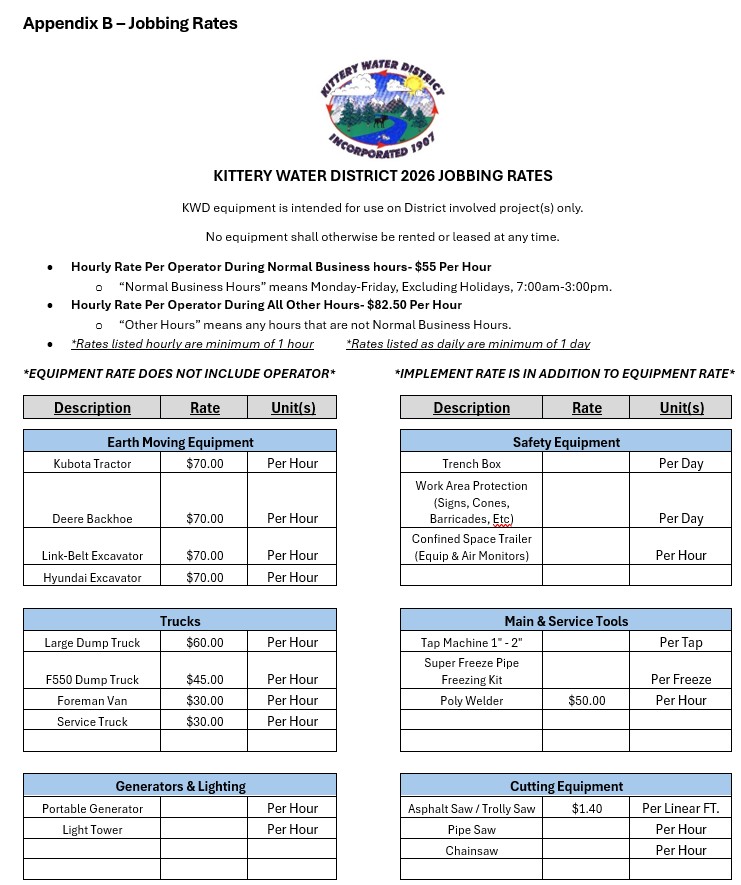
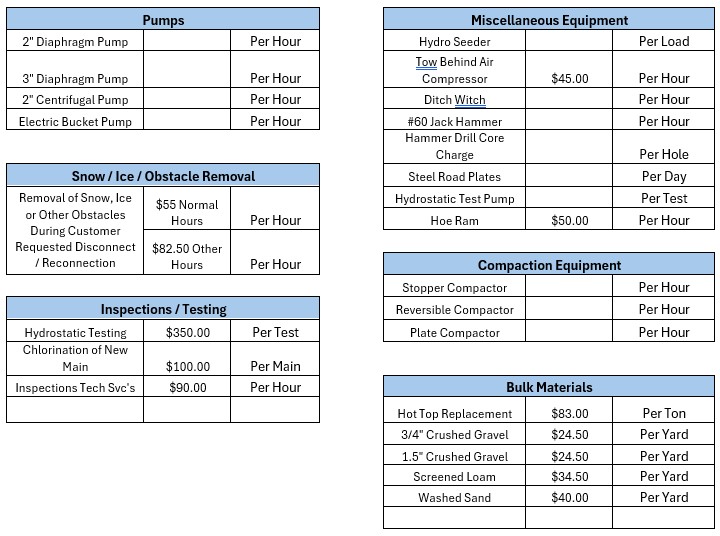
A Customer shall complete a written application before the Utility will provide unregulated Utility service. As permitted by Chapter 620 of the Commission’s Rules and Regulations, the Customer shall pay a deposit equal to the Utility’s written estimate. Unless the work is performed at a flat rate, the Utility shall return any excess deposit upon completion. If the final cost exceeds the deposit, the Customer shall pay any additional amount due upon completion. See Appendix A for the Fee Schedule and Appendix B for the Jobbing Rates.
28.FIRE HYDRANTS
Fire hydrants shall not be used for any purpose other than fire suppression unless prior permission is granted by the Utility. In the case of training exercises conducted by a Fire Department, the Utility shall be notified both prior to the exercise and immediately upon completion. In the event of fire suppression, the Fire Department shall notify the Utility of hydrant use within a reasonable time after the fire has been declared under control to allow for proper maintenance. In addition to notifying the Utility by telephone at the time of any hydrant use, Fire Department personnel shall complete a hydrant usage report for each event, including estimated water usage for each hydrant used, and shall submit the report electronically to the Utility within seven days. Fire Departments shall also submit a year-end summary of hydrant usage to the Utility, detailing the number of hydrants used for training and fire suppression and the total estimated water usage for the year.
Fire hydrants shall not be opened by any person other than an authorized agent of the Utility. The Utility shall be given timely notice so that a Utility representative may be available to witness the opening of hydrants during any fire hydrant flow test.
The Utility reserves the right to meter any fire line if it has reason to believe water is being used for purposes other than fire protection.
29. FIRE HYDRANT FLOW TEST CHARGE
A hydrant flow test shall be requested in writing or by telephone. Tests shall be scheduled at a time convenient to the Utility and in a manner that will not adversely affect the system or its Customers. The Utility shall receive a copy of the flow test results. The applicable charge for a single hydrant flow test shall be as set forth in Appendix A. See Appendix A for the Fee Schedule and Appendix B for the Jobbing Rates.
30. FIRE HYDRANT CONSTRUCTION METER / BACKFLOW RENTAL CHARGE
A hydrant construction meter and backflow setup is a device installed on a fire hydrant for use during construction activities. The device is intended to protect the Utility’s distribution system. The Utility supplies these devices to contractors, and the devices are costly to replace if returned damaged, lost, or not returned. Requests for a hydrant construction meter and backflow setup shall be made at least three business days prior to the requested delivery date to help ensure availability.
- Fire Hydrant Usage Instructions:
- Improper operation of fire hydrants may cause severe damage to the Utility’s water distribution system and surrounding property. By renting and using a hydrant construction meter and backflow setup, the renter agrees to fully compensate the Utility and any other affected party for all damages arising from or related to the renter’s use of the device.
- The Utility shall operate the fire hydrant, and the renter shall operate only the auxiliary valve or valves on the backflow device, including opening and closing such valves slowly to prevent damage to the water system.
- The renter/contractor shall be responsible for protecting all equipment from damage, freezing, and similar conditions.
- Hydrant Meter Fees and Charges: Applicable fees, charges, deposits, and water use rates for hydrant construction meters and backflow setups shall be as set forth in Appendix A. See Appendix A for the Fee Schedule and Appendix B for the Jobbing Rates.
31. PRIVATE FIRE PROTECTION
Customers requiring private fire protection service shall contact the Utility to determine the availability of such service at the Customer’s location. If available, the private fire protection Service Line shall be installed at the Customer’s expense within the bounds of the public way or right-of-way. After installation, the portion of the line located within the public way or right-of-way shall be owned and maintained by the Utility, as specified in Chapter 640 of the Commission’s Rules and Regulations. The Utility does not guarantee any quantity of water or pressure available through a private fire protection service. Private Fire Protection Service Lines shall be considered Service Lines for the purposes of these Terms and Conditions and shall not be used for domestic water use. Applicable rates for private fire protection service are set forth in Appendix A.
Customers wishing to test or flush their private fire protection systems are encouraged to do so during the months of May and October. Any Customer choosing to test or flush during those periods shall provide the Utility with at least two business days’ notice. If the Customer wishes to conduct a test or flush at any other time, the Customer must first obtain the written permission of the Utility.
The Customer shall also compensate the Utility for the actual cost of any public notice of the test or flush determined by the Utility to be reasonable and necessary, and for the cost of any flushing of the system determined by the Utility to be reasonable or necessary to correct any water discoloration caused by the Customer’s testing or flushing. See Appendix A for the Fee Schedule and Appendix B for the Jobbing Rates.
PROPOSED EFFECTIVE: 7/1/2026
EFFECTIVE: July 1, 2026
DOCKET NUMBER: 2026-00139
Michael Melhorn – President